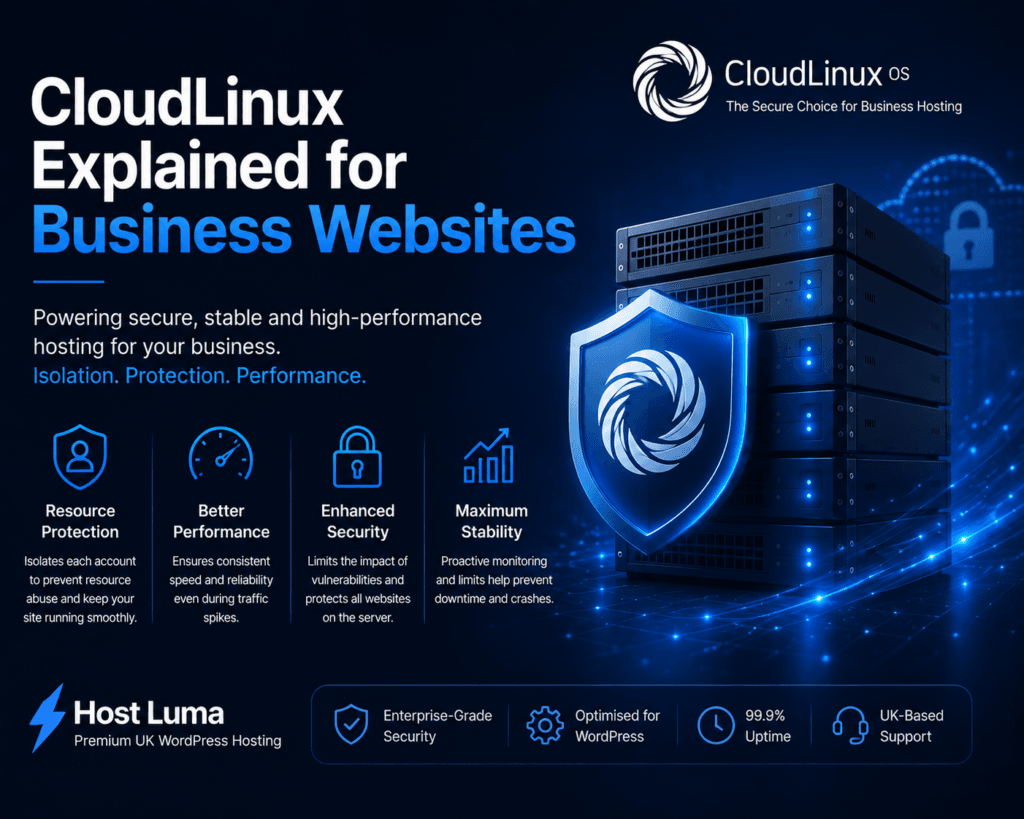
CloudLinux Explained for Business Websites
CloudLinux Explained for Business Websites
Website reliability is critical for modern businesses. Slowdowns, crashes or resource spikes from other websites on the same server can damage customer trust and impact revenue.
This is where CloudLinux becomes extremely important for professional web hosting environments.
What Is CloudLinux?
CloudLinux is a specialised operating system designed specifically for shared hosting and managed hosting environments.
It improves server stability, security and performance by isolating hosting accounts from each other.
Instead of all websites competing freely for server resources, CloudLinux creates controlled resource limits and account isolation.
- Server slowdowns caused by abusive websites
- Resource spikes affecting other customers
- Account instability during traffic surges
- Cross-account security risks
- Server overload situations
How LVE Resource Isolation Works
One of CloudLinux’s most important features is LVE (Lightweight Virtual Environment) technology.
LVE isolates each hosting account and controls how many server resources it can use.
This includes:
- CPU usage
- Memory usage
- Disk I/O
- Entry processes
- Concurrent connections
If one website suddenly experiences excessive traffic or resource usage, CloudLinux prevents it from slowing down other websites on the server.
Why This Matters for Business Websites
Business websites need predictable performance and uptime.
Without proper isolation, poorly optimised websites or malicious traffic on neighbouring accounts can impact completely unrelated websites.
⚡ Better Stability
Resource isolation helps websites remain responsive and stable.
🛡️ Improved Security
Account isolation reduces cross-account security risks.
📈 More Consistent Performance
Websites are protected from neighbouring resource spikes.
CloudLinux and PHP Optimisation
CloudLinux also provides advanced PHP management capabilities through technologies such as:
- PHP Selector
- Alt-PHP versions
- Optimised PHP handling
- Per-account configuration control
This allows hosting providers to improve compatibility, stability and performance for WordPress websites and business applications.
Enhanced Hosting Security
Security is another major advantage of CloudLinux hosting.
By isolating accounts, CloudLinux helps reduce the risk of websites affecting one another during security incidents.
Traditional shared hosting environments without strong isolation can allow server-wide issues to spread more easily between accounts.
Handling Traffic Spikes More Efficiently
Traffic spikes from advertisements, social media or search engine visibility can create sudden server load increases.
CloudLinux helps maintain platform stability by controlling how server resources are distributed.
This improves:
- Website responsiveness
- Overall uptime
- Server reliability
- Customer experience
Why Host Luma Uses CloudLinux
At Host Luma, CloudLinux forms a core part of our managed WordPress hosting platform.
We combine CloudLinux with:
- LiteSpeed Enterprise
- NVMe storage
- JetBackup 5 protection
- WordPress caching optimisation
- Performance-focused server tuning
This creates a hosting environment designed for reliability, security and fast WordPress performance.
Who Benefits Most from CloudLinux Hosting?
CloudLinux is especially beneficial for:
- Business websites
- WooCommerce stores
- Agency websites
- Membership platforms
- High-traffic WordPress blogs
Any website requiring stability and consistent performance can benefit from CloudLinux infrastructure.
Looking for Reliable Managed WordPress Hosting?
Host Luma combines CloudLinux, LiteSpeed Enterprise, NVMe storage and JetBackup 5 to deliver secure, high-performance WordPress hosting.
Visit Host LumaRelated Articles
Learn how NVMe infrastructure improves website performance.
Discover why automated backups are critical for reliability.
Explore our layered hosting security systems.
Written by Host Luma
Host Luma is a UK-based managed WordPress hosting provider focused on performance, security and reliability using LiteSpeed Enterprise, CloudLinux, JetBackup 5 and NVMe infrastructure.




Need Faster WordPress Hosting?
Discover fully managed WordPress hosting with LiteSpeed Enterprise, free CDN, automated backups and proactive WordPress maintenance.
Written by Host Luma
Host Luma is a UK managed WordPress hosting provider focused on performance, security and reliability using LiteSpeed Enterprise, CloudLinux, BunnyCDN and NVMe infrastructure.
Related Articles

When the Internet Broke: What the 2021 Fastly Outage Teaches Every Business Owner About Website Uptime
On 8 June 2021, at approximately 10:58 AM British Summer Time, something strange happened. The Guardian…

The British Airways Data Breach: What Every Small Business Owner Needs to Learn From a £20 Million Mistake
On 6 September 2018, British Airways made an announcement that would cost them twenty million pounds.…
Why Your WordPress Site Is Slow (And How to Fix It Without 20 Plugins)
If your WordPress website feels slow, you’re not alone. Most site owners install plugin after plugin…