Technical SEO Basics for WordPress Site Owners
Technical SEO Basics for WordPress Site Owners
This article assumes something is already wrong: a poor PageSpeed Insights result, a GTmetrix waterfall that looks noisy, a WordPress admin warning, a checkout complaint or a DNS change that has not landed cleanly.
A good investigation leaves a trail: the URL tested, the tool used, the visitor state, the cache state and the WordPress setting or asset that explains the symptom.
A sensible first pass is time-boxed. Spend 10 minutes reproducing the issue, 10 minutes reading the waterfall or admin evidence, and 10 minutes deciding the safest reversible change. If you cannot name the bottleneck after that, collect better evidence before touching settings.
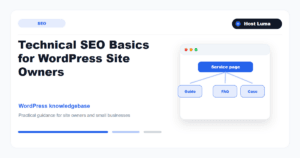
How articles support service pages
A WordPress SEO issue around technical SEO WordPress often starts outside the editor. Crawlability, Core Web Vitals, redirects, canonicals and internal links determine whether good content can be found and used.
- important URLs are missing from the sitemap
- redirects or canonicals point to old locations
- slow templates affect search landing pages
- metadata repeats across pages
For SEO work, keep a crawl export before changes. Titles, descriptions, canonicals, status codes, indexability and redirect targets are easier to compare from a file than from memory.
Internal links that help users
Use the tools for different questions rather than running them all and hoping one gives a simple answer.
- Search Console
- site crawl export
- PageSpeed Insights URL groups
- WordPress SEO plugin fields
- server redirect rules
Avoiding overlapping search intent
- 1. crawl before changing content
- 2. map redirects before migrations
- 3. link related articles to useful service and knowledgebase pages
- 4. measure Core Web Vitals on pages with organic traffic
Technical SEO work should start with crawl data and search-visible templates. A useful content change can still fail if redirects, canonicals, noindex rules, Core Web Vitals or internal links are wrong.
Decision point for technical SEO WordPress
For technical SEO WordPress, decide whether the issue is discoverability, relevance, performance or migration hygiene. A rewrite will not fix a blocked page, a missing redirect, a poor mobile URL group, a bad canonical or a sitemap full of URLs that should not be indexed.
Keep a small change log beside the work. Record the previous value, the new value, the cache purge performed and the exact URL retested. That makes rollback possible when a later plugin update changes the behaviour.
Artefacts to keep for technical SEO WordPress
The artefact set should answer a simple question: if this breaks again next month, what would help someone understand the original fix quickly?
- Crawl export with status codes, titles, canonicals and indexability.
- Search Console URL group or Core Web Vitals screenshot.
- Redirect map for changed URLs and sitemap after launch.
Structure mistakes
- rewriting copy before technical checks
- publishing overlapping articles
- leaving staging noindex active
Record the exact before-and-after condition for this topic: URL, test tool, metric, setting or file changed, cache purge used and the retest result. That note matters more than a vague claim that the site feels better.
The last test before you stop
- Recrawl the affected URLs and compare status codes, canonicals and indexability.
- Check Search Console or PageSpeed URL groups after enough data is available.
- Confirm internal links and service-page paths still make sense for users.
Questions about content structure
How does technical SEO WordPress affect SEO?
technical SEO WordPress should be checked against the failing URL, not a generic checklist. Use the symptom, the tool output and the WordPress layer involved to decide the next action.
Which URLs should be tested?
technical SEO WordPress should be checked against the failing URL, not a generic checklist. Use the symptom, the tool output and the WordPress layer involved to decide the next action.
What should be monitored after changes?
technical SEO WordPress should be checked against the failing URL, not a generic checklist. Use the symptom, the tool output and the WordPress layer involved to decide the next action.
One final check matters: repeat the original failing action after the fix. If the visitor problem was tapping a booking button, do not close the work because the homepage score improved.
For SEO, add the crawl boundary. A page can have strong content but fail because it is noindexed, canonicalised elsewhere, redirected badly, omitted from the sitemap or too slow on the template that receives search traffic.
After an SEO fix, monitor the same URL group. Search Console, crawl exports and server logs will show whether redirects, Core Web Vitals and indexability changed in the expected direction.
Also check ownership of redirects. A redirect map should explain why important URLs changed, where they now point and whether the destination still satisfies the original search intent.
Do this before changing production settings, not afterwards.
Record the result so the next reviewer can understand the change.
Use the same URL for the control retest so the comparison means something.
If the result is unclear, pause and gather sharper evidence before changing another setting.
Make rollback boring: keep the previous setting, backup point or purge note close to the change.
When the issue involves Core Web Vitals, record which metric you are trying to move before changing settings. LCP, INP and CLS often need different fixes, so one combined score is not enough evidence.
Summary
A good fix leaves the site easier to support. The cache rules are known, the CDN behaviour is verified, the WordPress setting is documented and rollback is possible if the next update changes the result.
Need Faster WordPress Hosting?
Discover fully managed WordPress hosting with LiteSpeed Enterprise, free CDN, automated backups and proactive WordPress maintenance.